


Clara Barciela
Hi, I’m Clara. I wrote this to help you plan your trip more authentically, with more clarity and less overwhelm.
Is summer a good time to visit Peru? The answer is yes—but only if you understand how the season shapes the experience. While this time of year brings rain to the Andes, it also offers something many travelers value even more today: fewer crowds, greener landscapes, and a more flexible way to explore.
For travelers coming from the U.S. who are looking for a well-paced, thoughtfully designed journey, summer in Peru can feel quieter, more personal, and far more connected—if planned the right way.
Is Summer a Good Time to Visit Peru?
Yes—summer can be a beautiful time to visit Peru, especially for travelers who value fewer crowds, more flexibility, and a more personal pace of travel. The key is designing the itinerary around seasonal patterns and experience flow—not just destinations.
If thoughtfully planned, this time of year allows you to experience Peru in a quieter, more intentional way—where each place feels less rushed, and every moment has space to unfold naturally.
For many of the travelers we work with, this is exactly what transforms a trip from something you see into something you truly feel.
→ See how we design Peru journeysYou don’t usually hear “summer” and “Peru” in the same sentence—at least not as the obvious choice.
But lately, I’ve noticed something interesting.
Many of the travelers we work with—especially those coming from the U.S.—are no longer asking, “When is peak season?” They’re asking something very different:
“When will it feel right?”
According to the latest Virtuoso Luxe Report, luxury travelers are actively shifting the way they plan their journeys. They’re prioritizing fewer crowds, more meaningful experiences, and better pacing over simply checking off destinations at the “right” time of year.
And that’s exactly where Peru in summer becomes interesting.
Because while this time of year is often overlooked due to the Andean rainy season, it also offers something many travelers value even more today: space, flexibility, and the opportunity to experience Peru in a more intimate and unhurried way.
From our experience designing journeys across Peru, this is where thoughtful planning makes all the difference.
Why Summer Feels Different
Summer in Peru (December to March) brings a different rhythm to the country.
In the Andes, landscapes turn lush and green. In cities like Lima, the coastal energy comes alive. And across the country, you’ll often find fewer international travelers compared to peak months.
For many of our clients, this shift is exactly what makes the experience feel more personal.
Weather Across Regions in Summer
As you plan your summer trip to Peru, keep in mind that the country spans the Andes Mountains, the Amazon Rainforest, and the Pacific Coast, each offering distinct climates and experiences.
So, Peru is not a single climate—it’s a combination of regions, each behaving differently during summer.
✔️Lima & the Coast: warm, sunny, and vibrant
✔️Cusco & Sacred Valley: rainy season, but with dramatic green landscapes
✔️Machu Picchu: open year-round, with occasional rain showers
✔️The Amazon: lush, humid, and full of life
Peru is not a single climate—it’s a country shaped by distinct regions, each behaving very differently during the summer months.
Along the coast, particularly in Lima, summer brings long, sunny days and a vibrant energy to the city. It’s one of the best times of year to enjoy its restaurants, neighborhoods, and ocean views.
In the Andes, including Cusco and the Sacred Valley, this is the green season. While you may encounter afternoon showers, the landscapes become dramatically lush, and the overall atmosphere feels quieter and more relaxed.
In the Amazon, higher water levels make exploration deeper and more immersive, allowing access to areas that are not always reachable during drier months.
Understanding these regional differences is what allows a summer itinerary in Peru to feel effortless rather than unpredictable.

Pros and Cons of Traveling in Summer
If you’re wondering whether summer is a good time to visit Peru, the answer isn’t a simple yes or no.
It depends on what kind of experience you’re looking for—and how thoughtfully the trip is designed..
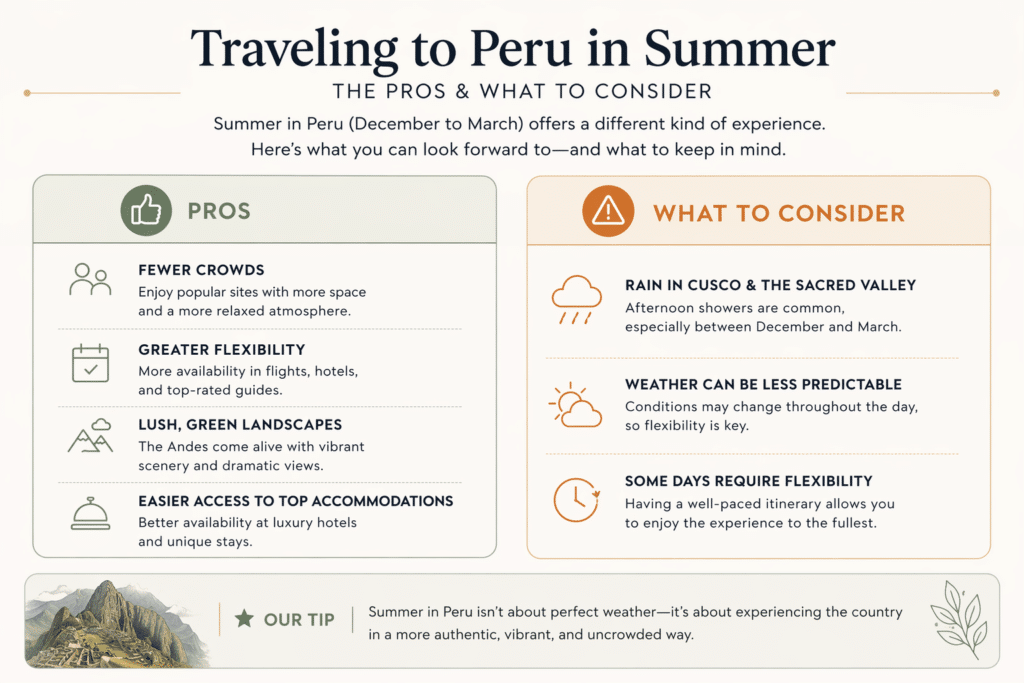
Pros of traveling to Peru in summer
Fewer crowds, especially in the Andes
Greater flexibility in planning and availability
Lush, green landscapes that feel more alive
Easier access to top accommodations and guides
What to consider
Rain in Cusco and the Sacred Valley
Weather can feel less predictable day-to-day
Some experiences require flexible timing
Understanding the Main travel Seasons in Peru
Before deciding when to travel, it helps to understand how seasons actually work in Peru—because they don’t align with what most travelers from the Northern Hemisphere expect.
Rather than four distinct seasons, Peru is shaped by two main travel rhythms: the dry season and the green season.
High Season (Dry Season): May to September
This is when the Andes experience clearer skies and more stable weather, making it a popular time for visiting Cusco, the Sacred Valley, and Machu Picchu.
What travelers value during this time:
More predictable weather conditions
Ideal for exploring the Andes with minimal rain
Strong overall demand and vibrant atmosphere
What to keep in mind:
Higher demand for top accommodations and guides
Popular sites can feel more crowded
Green Season (Summer): December to March
This is when Peru feels at its most vibrant and alive—especially in the Andes, where landscapes turn intensely green.
What travelers appreciate:
Fewer crowds and a more relaxed pace
Lush scenery and a different visual experience
Greater flexibility in planning and availability
What to consider:
Afternoon rain showers in the Andes
Itineraries benefit from thoughtful pacing and flexibility
Understanding these seasonal patterns is what allows a journey through Peru to feel intentional rather than reactive—choosing not just when to travel, but how you want the experience to unfold.
Where to Go in Peru in Summer (Based on How You Want to Travel)
Instead of thinking in terms of regions, it helps to think about how you want your trip to feel.
Because in summer, Peru isn’t about finding the “perfect weather”—it’s about choosing the right combination of places.
If you’re drawn to culture, food, and vibrant cities
Lima comes alive in summer, with long, sunny days, ocean views, and one of the most exciting dining scenes in South America.
For many of our travelers, this is where the journey begins—an easy, elegant way to recover from the flight while already feeling connected to the destination.
If you want iconic landscapes with a quieter atmosphere
Cusco and the Sacred Valley offer something very different this time of year.
Yes, it’s the rainy season—but it also brings fewer crowds and intensely green landscapes that feel more alive than in the dry months.
With the right pacing, this part of the journey can feel slower, more personal, and deeply immersive.
If Machu Picchu is a must (and it usually is)
Machu Picchu remains open year-round.
During summer, occasional rain showers are part of the experience—but so are fewer visitors, which can make the visit feel less rushed and more intimate.
The key is thoughtful timing and planning.
If you’re looking for nature and immersion
The Amazon is at its most vibrant during the summer months.
Higher water levels allow for deeper exploration by boat, reaching areas that are not accessible during the dry season.
For travelers seeking something immersive and different, this often becomes one of the most memorable parts of the journey.
If you’re thinking in terms of specific destinations, here’s how each region fits into a well-designed summer journey through Peru:
- Lima in Summer: warm, vibrant, and full of energy—ideal as the starting point of your journey.
- Cusco & Sacred Valley in Summer: greener, quieter, and more atmospheric than during peak season.
- Machu Picchu in Summer: open year-round, with fewer crowds and a more flexible rhythm.
- The Amazon in Summer: at its most immersive, with deeper access and richer wildlife experiences.
If you’re starting to picture how this could come together, you can explore a few of our Peru itineraries here.
→ Explore our Peru journeysHow to Plan a Summer Trip the Right Way
Planning a trip to Peru in summer isn’t about avoiding the season—it’s about understanding how to work with it.
Because what makes the difference isn’t the weather itself, but how the journey is designed around it.
For many of the travelers we work with, this is where the shift happens—from trying to “fit everything in” to creating a trip that actually flows.
That means choosing the right sequence of destinations, allowing space between transitions, and building in flexibility where it matters most.
It also means knowing when to slow down.
In summer, Peru rewards travelers who move with intention—spending time in fewer places, going deeper into each experience, and allowing the journey to unfold naturally rather than rushing from one highlight to the next.
From our experience, this is what transforms a trip from something that feels logistically complex… into something that feels effortless.
What we’ve learned over the years is simple: there’s no single “perfect” itinerary for Peru—only the one that’s designed around how you want to travel.
If you’re starting to think about your trip and want to get it right from the beginning, a strategy session can help you map out the best timing, pacing, and route based on how you want to experience Peru.
→ Start planning your trip with usMistakes to Avoid when Planning your Summer trip to Peru
Planning a trip to Peru in summer isn’t difficult—but there are a few common mistakes that can make the experience feel more complicated than it needs to be.
The first is trying to do too much in too little time. Peru isn’t a destination you rush through, and in summer especially, a well-paced itinerary makes all the difference.
Another common mistake is treating the country as if it had a single climate. What works in Lima doesn’t necessarily apply to Cusco or the Amazon—and understanding those differences is key to designing a smooth journey.
We also often see travelers planning too rigidly. Summer in Peru rewards flexibility. Building in some breathing room allows you to adapt naturally to weather patterns without feeling like your trip is being disrupted.
And finally, assuming that summer is “not a good time to go.” In reality, it can be one of the most rewarding times to experience Peru—if the trip is designed with the season in mind.
Signature Experiences in Peru During Summer
Peru in summer isn’t about seeing more—it’s about experiencing things differently.
With fewer crowds and a more flexible rhythm, many moments feel more personal, more immersive, and more connected to the place itself.
Machu Picchu, experienced differently
Machu Picchu is never just a visit—it’s a moment.
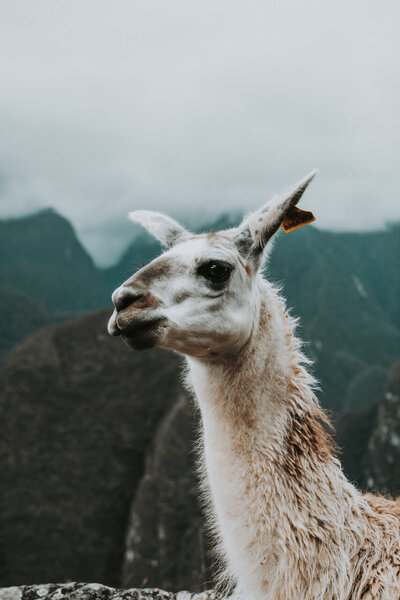
During summer, occasional rain becomes part of the atmosphere, often creating misty views that add to the sense of discovery. With fewer visitors than in peak months, the experience can feel quieter and more intimate.
A private guide, well-timed entry, and a thoughtfully paced visit make all the difference.
The Sacred Valley, at a slower pace
In summer, the Sacred Valley feels greener, softer, and more alive.
This is where many travelers begin to slow down—spending more time in fewer places, connecting with the landscape, and enjoying experiences that feel less rushed and more intentional.
The Amazon, at its most immersive
Higher water levels during summer open up deeper parts of the rainforest.
Exploring by boat allows access to remote areas, creating a sense of immersion that feels completely different from the rest of the journey.
For many travelers, this becomes one of the most unexpected highlights of the trip.


Cultural Moments You Can Experience in Summer
Exploring Peru during the summer offers you enriching experiences steeped in a deep cultural history and vibrant local traditions.
- Semana Santa (Holy Week): a powerful blend of religious and local traditions
- Local markets and artisan communities: more relaxed and authentic outside peak months
- Daily life in Cusco and the Sacred Valley: slower, more connected, and less driven by crowds
These moments often become the ones travelers remember most.
If you’re still figuring out how to structure your trip, this Peru itinerary in 7 days will help you understand how to plan the journey in a way that actually flows.


Plan Your Peru Journey with Us
Peru in summer isn’t about perfect conditions—it’s about the kind of experience you’re looking for.
For travelers who value space, flexibility, and a more personal rhythm, it can be one of the most rewarding times to explore the country.
The key is designing the journey in a way that works with the season, not against it.
If you have your vacation dates but are wondering, “Oh, where do I begin?”
We can help: Start here.
Or, start by checking out our suggested trips to visit Peru in South America.
Clara
If you’re starting to think about your trip and want to get it right from the beginning, a strategy session can help you map out the best timing, pacing, and route based on how you want to experience Peru.
→ Start planning your trip with usFrequently Asked Questions
This section aims to address common queries regarding summer travel in Peru, ensuring you’re well-prepared for your adventure.
How should I pack for a 10-day trip to Peru during summer?
Pack lightweight and breathable clothing for the daytime, with layers for cooler evenings. Include a good pair of hiking shoes, sun protection, and versatile clothing suited for Peru’s varied climates.
What kind of weather can I expect during the summer months in Peru?
Summer in Peru, from December to February, generally offers warm weather on the coast. However, in the highlands and the Amazon rainforest, it can be quite different with the rainy season in full effect which means warmer temperatures but frequent rain showers.
What are the top things to do in Peru during the summer season?
You can visit coastal towns like Máncora for beach activities, explore the highlights of Lima, or attend cultural festivals. Do not miss the vibrant Inti Raymi festival in Cusco, which takes place every June.
When is the rainy season in Peru and how might it affect my visit to Machu Picchu?
The rainy season in Peru lasts from November to April. Visiting Machu Picchu during this time may result in less crowded tours but you’ll face a higher chance of rain, which can sometimes obstruct the view of the ruins.
What is considered the hottest month in Peru and where does it hit peak temperatures?
February is regarded as the hottest month, especially in the coastal regions. Cities like Ica and Piura often experience the highest temperatures, sometimes surpassing 30°C (86°F).
When is the best time of year to plan a visit to Machu Picchu for good weather?
The best time to visit Machu Picchu is during the dry season from May to September when you’ll encounter less rain and clearer skies, making your experience exploring the ancient Inca ruins more comfortable.
Summer in Peru: Is It a Good Time to Visit?
MEET US
Blog